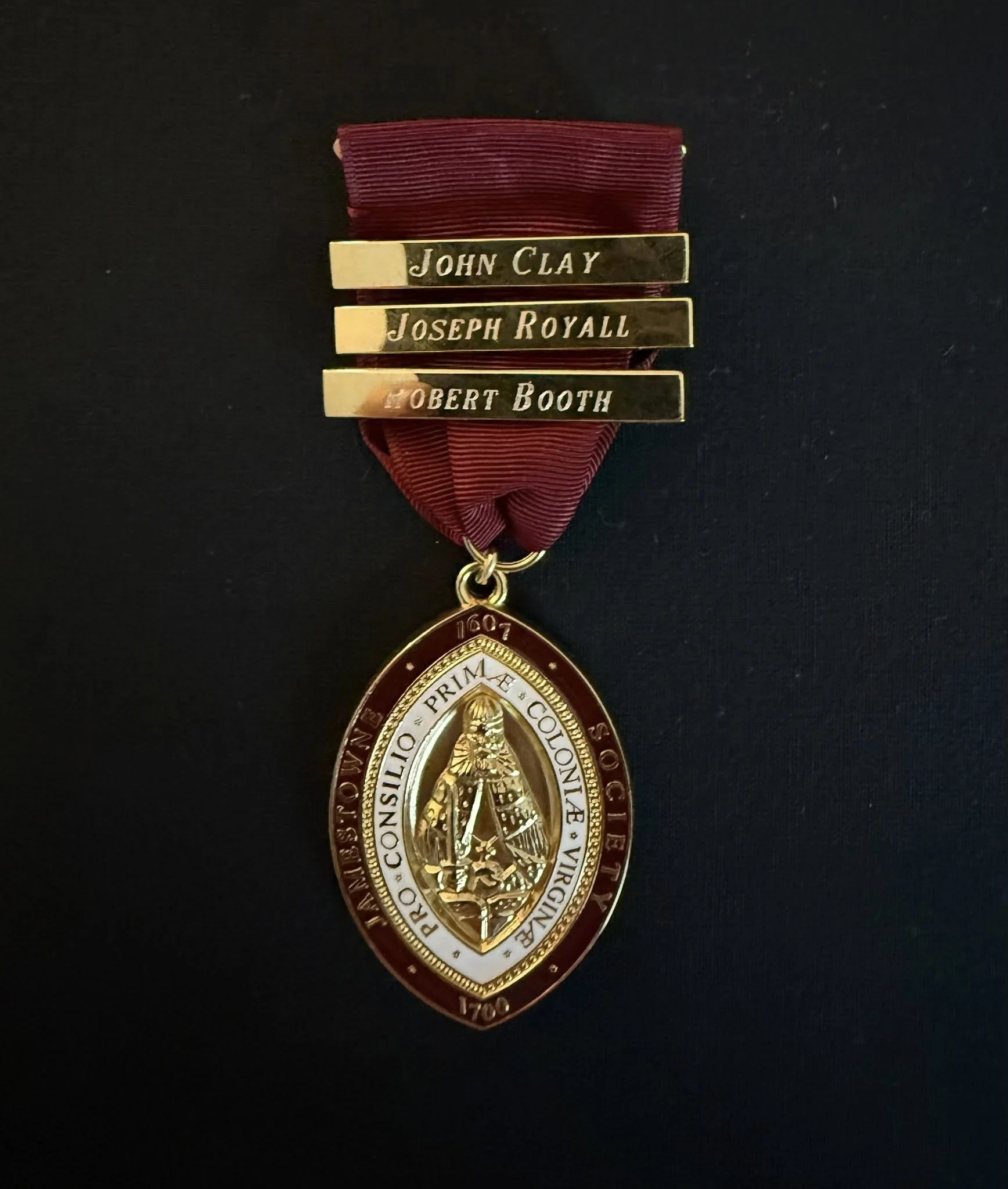
As an active member of the Jamestowne Society, I can attest that becoming a member of a lineage society is more than a ceremonial achievement—it is a deeply personal journey into identity, legacy, and historical stewardship. Organizations like the Jamestowne Society and the Hereditary Order of the Families of the Presidents and First Ladies of America, of which I am also a member, offer individuals the opportunity to formally recognize and preserve their ancestral connections to the founding chapters of American history.

For years, genealogy was a passion. I loved the thrill of finding the pieces of a complex puzzle, which, when pieced together, told a forgotten ancestral story. But at some point, I began to wonder: Was my research reliable, and did it meet current standards?
These questions led me to pursue the Certified Genealogist® (CG®) credential from the Board for Certification of Genealogists® (BCG). I wanted to know whether my research and writing could stand up to professional scrutiny—not for bragging rights, but for confidence, growth, and a deeper understanding of the craft I loved.

What is the next step after we, as genealogists, collect evidence in pursuit of a sound conclusion for a research objective? In accordance with the Genealogical Proof Standard’s Step 3, we thoroughly analyze and correlate all the evidence we gather. Imagine a giant puzzle, each piece must fit perfectly into its adjacent pieces.

Where do we begin when researching Virginia’s antebellum free people of color? As with all genealogical research, it depends on multiple factors, two of which are legal and historical context. Equally important, what is the research objective?

Although it takes much effort, time, and cost, acquiring the skills to conduct genealogical research that meets today’s standards is well worth the investment and time. It does take years to learn, and the learning never stops. If you do not have the inclination or time to invest in education and are interested in learning of your ancestry, do yourself and future generations of your family a favor and hire a professional to conduct the research for your family tree. It will be well worth the investment.

Long before I knew there was an official term for it, I found it necessary and interesting to identify and document clusters of people that shared a common thread or threads. Once complete, this type of research “a ha” moment gets to me to this day. Genealogical research in the United States before 1850 often involves researching extended family members or collateral families, which can often be the difference in obtaining evidence to answer a research question.

The foundation of professional genealogy is based on best research practices that produce reliable findings. Just as a house should be built on a solid foundation, genealogy research should begin with a solid foundation. Otherwise, how reliable can our research findings be?

Online trees are notorious for providing little evidence, such as one or two census records, to state a conclusion of relationship. Or, some trees provide a list of documents without an explanation as to how each relates to the other. It’s not enough to provide a list of sources/documents that are used in reaching our conclusion. It is our responsibility as researchers to explain why and how each source is used in forming the conclusion we reached.

We often run into conflicting evidence while researching. Sometimes reconciliation of conflicting evidence items is simple. Often the puzzle can be a lot more complex. No matter how simple or complex a resolution may be, Genealogy Standards states that in order to reach a sound conclusion, we as researchers must resolve any and all conflicts between evidence items. Otherwise, we cannot form a sound conclusion.